

Cassy Judy deals with the topic of death in an unexpectedly light-hearted way, transforming a serious subject into one that can lead to laughter, shared experiences and discussion. The song was written after the death of the father of Jewelz and Lisa Hanssens, and it came about from a wish to provide a opportunity for people to talk about death before it happens, such as the kind of music they would like to have playing at the end of their lives. Instead of handling the subject in a serious manner only, Cassy and her collaborators deal with it with humour and an openness which is what gives the song its special character.
The song was produced as part of a songwriting workshop organised by Jewelz for Cark it Cafe, and it involves Cassy Judy, Jewelz, Lisa Hanssens, Pixie Willow and Rachel Morley. Collaboration plays a central role in the song’s story, the workshop serving as the setting in which all of them contributed to the writing. Cassy says that it was the most enjoyable songwriting experience she has ever had and that this feeling of shared enjoyment is closely linked to the song’s release. What started as a response to a personal loss has become a collective creative effort.
‘Orchestra of Death’, which was recorded in Derek J. Turner’s shed in Gymea Bay, does not shun unconventional ideas but instead embraces them. A particularly unusual element of it is the deliberate inclusion of farting which nevertheless ended up being recorded even though Derek was against the idea. The dog Muffin sometimes also took part in the sessions, thus adding another aspect to the unconventional way in which the recording was carried out. Inspiration for the playful nature of the song came from Serge Gainsbourg’s ‘Comic Strip’, especially in relation to its use of onomatopoeia, and this helps to account for the song’s commitment to humour and fearless experimentation.
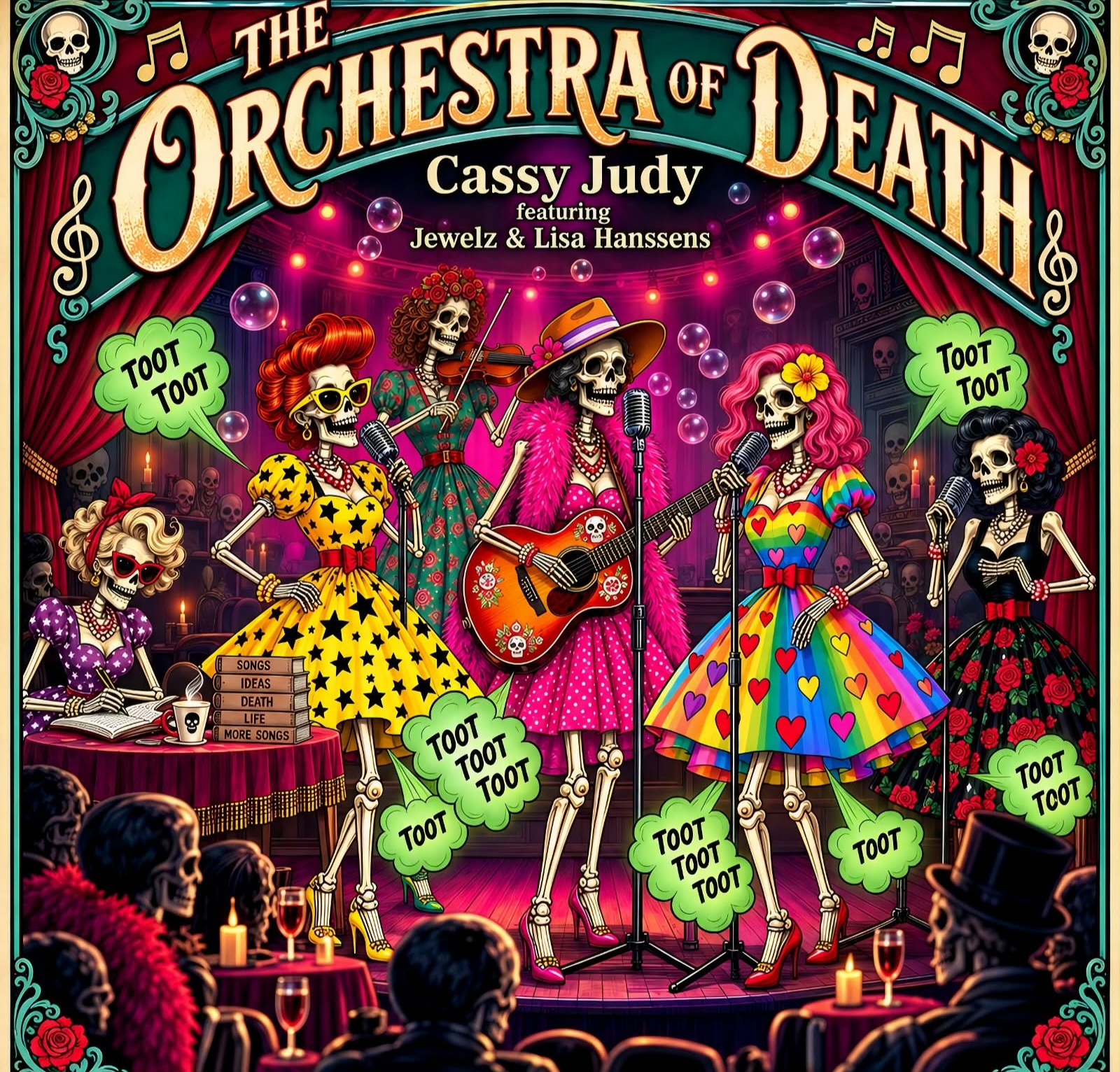
By combining a serious topic with a cheeky attitude, “Orchestra of Death” encourages people to discuss death without thinking that such conversations have to be always serious. The fact that it is a collaborative project and the unusual decisions regarding the recording show that it has been shaped by friendship, creativity, and a readiness to find humour in odd situations. Cassy Judy transforms a conversation started as a result of grief into a joint musical experience, enabling both laughter and reflection to be present together. It is a rather unusual record centred on a significant subject and based on a clearly playful concept.